Learn

Learn the neck, read music and tab, and the theory behind them.

Short exercises that tell you at once if you got it right: every note on the neck, the staff written for guitar, tab and its signs. And theory in short lessons drawn on the neck, no guitar needed. Against the clock, until the first slip or at your own pace, and any of them can be your teacher’s homework.

Nothing to install · Phone or computer

Read a riffNote 4 of 6
TAB030202
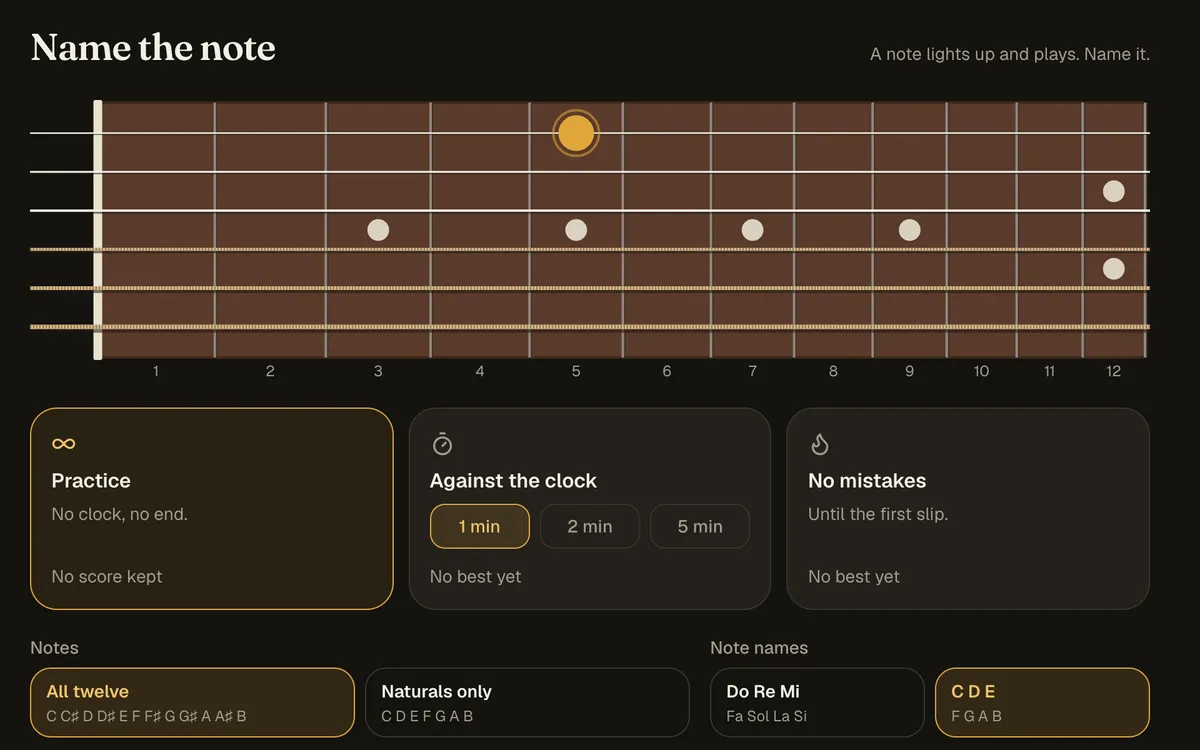
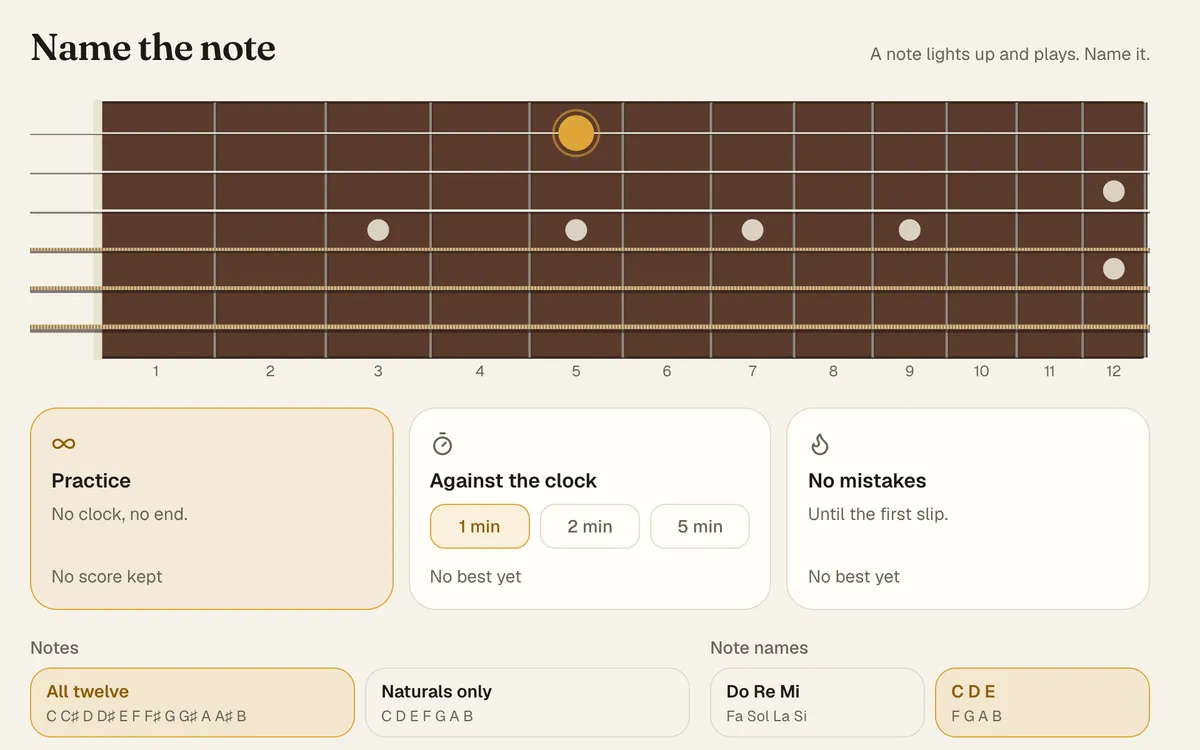
Name the note
Your best · 34 in a minute
Fretboard notes

Every note on the neck, by heart.

Name the noteA position lights and plays. Say which note it is: twelve buttons, or the letter keys on a computer.
Find the noteYou get a name. Tap every place it lives in frets 0 to 12, on six, seven or eight strings.
Hear the noteNext: a note sounds with nothing lit, and you find it on the neck.
Try Name the note, no account
diesis.app/learn/name-the-note
Name the noteName the note
Reading music

Read music written for guitar, from the staff to the neck.

By zone of the neck: up to fret 3, 7 or 12. The note sounds when you get it right, never before.
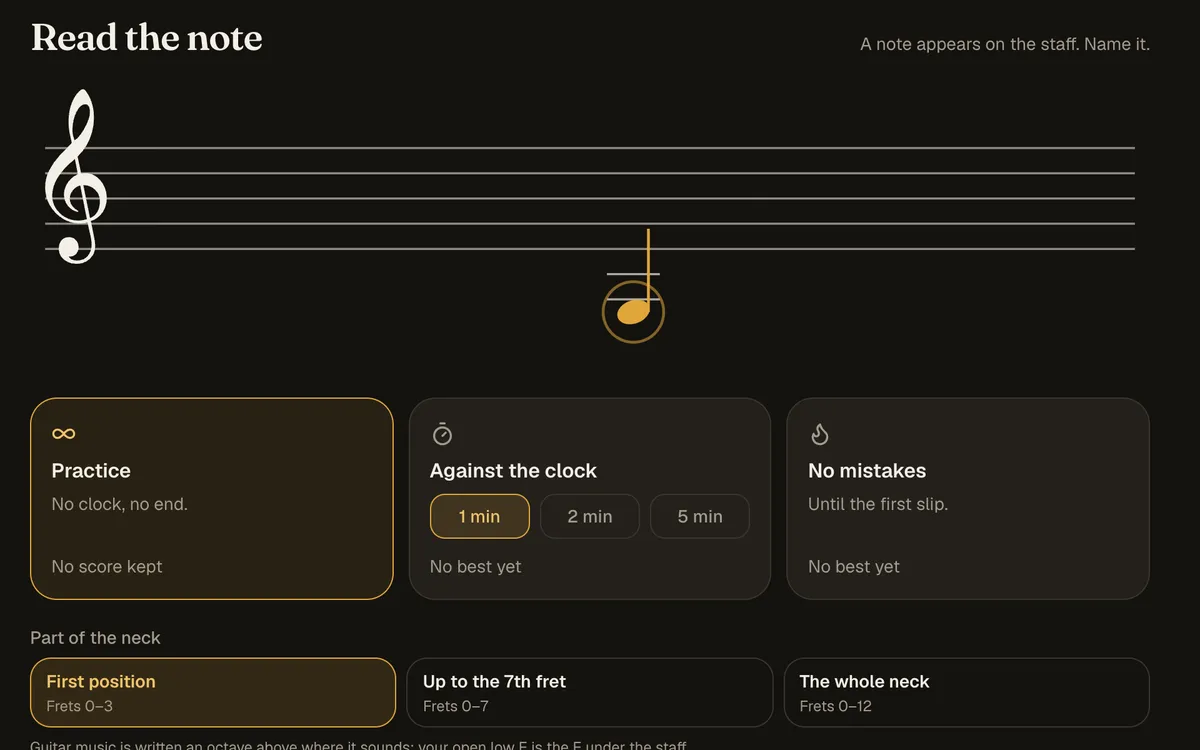
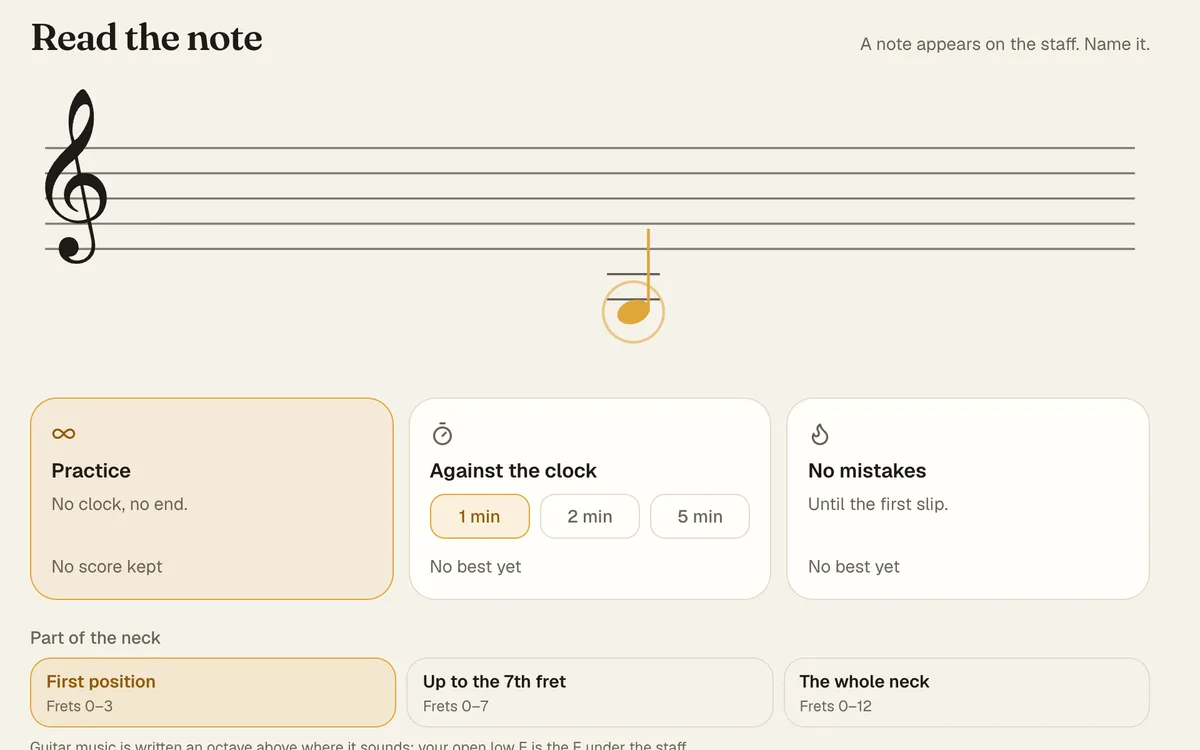
Read the noteA note on the staff, naturals only to begin with: name it.
Staff to neckThe staff above, the neck below: tap where it is.
Read a barFour notes by step, named in order.
Sight readingNotes scroll toward a line; the pace quickens as you get them right.
Read music in the app
diesis.app/learn/read-the-note
Read the noteRead the note
Tablature

Read tab as easily as text, signs included.

Tab is the neck seen from above: each line a string, each number a fret. Four exercises take you from one number to a whole riff and every sign in it.

1 · thinnest

6 · thickest

Tab to neckA number on a line: tap that string at that fret, on a neck with no fret numbers, as on your guitar.
Neck to tabA place lights up on the neck: write it as tab, the line and then the fret.
Read a riffA bar of riff, power chords included: play it on the neck in order, then hear it in time.
Tab symbolsh, p, b, r, slides, ~, x, P.M., harmonics, taps and ghost notes: what each asks you to do, and how it sounds.
Read tab in the app

How to read tab

  1. 01
    Each line is a stringThe top line is your thinnest string, the 1st; the bottom one your thickest. The neck as you see it looking down.
  2. 02
    The number is the fretPress that string at that fret and play it. A 0 is the open string.
  3. 03
    Left to right, stacked togetherRead it like text. Numbers stacked in one column are played at the same time.
  4. 04
    The rhythm is not writtenPlain tab says where, not how long: listen to the song, or look for the rhythm written above the tab.
Theory

Music theory on the neck, in lessons you can read on the phone.

A few minutes each: a sentence over the neck, a question you answer by tapping it, a line of why. Thirty-two lessons on eight shelves, from the semitone to the modes and the shuffle, and each one ends in the exercise or the tool that measures it.

Notes and distancesOne fret, one semitone; the twelve names; the octave shapes; why the B string moves everything one fret.
IntervalsEvery interval as a shape on two strings and as a sound from a song you know, from the minor second to the octave.
The major scale and keysTone, tone, semitone: build it on one string, name its degrees, and why G has one sharp and D two.
ChordsA triad from the interval shapes, major against minor one fret apart, power chords, the open chords read as triads, barre chords as a shape moved, sevenths.
Harmony in a keyThe seven chords of a key and their numerals, why I V vi IV sounds right, reading a chart in any key and transposing.
Minor keys and the modesThe relative minor, harmonic and melodic minor, and each mode by the one note that gives it its color, with the chord it fits over.
Pentatonics and positionsThe minor pentatonic as the minor scale minus two notes, the five boxes and how they join, the major pentatonic and the blue note, and the four steps from a box to a solo.
RhythmNote values, time signatures, dots, ties and syncopation, triplets, the shuffle and the gallop, each drawn as a strip you can hear.
Four exercisesName the interval, Find the interval, Build the scale and Build the chord: what the lessons end in, measured against the clock.
Open Theory in the app
Skills

Your techniques, your level and your teacher’s.

Fifteen techniquesAlternate picking, legato, bends, sweep, palm mute and more: left hand, right hand and expression. Add your own.
Two opinionsNot tried, Learning, Got it, Mastered: your level, and your teacher’s beside it with a note.
Nothing lockedNo levels Diesis hands out. The teacher’s Learned is the verdict; on your own, you are.
Your skills in the app
Alternate picking
YouGot it
Your teacherLearning
Bending
YouMastered
Your teacherGot it
Palm muting
YouLearning
Your teacherLearning
Sweep picking
YouNot tried
Your teacherNot tried
How it works

Exercises that tell you at once if you got it right.

Three challengesPractice with no clock, Against the clock for 1, 2 or 5 minutes, or No mistakes, until the first slip.
Your bests, keptEvery exercise keeps your best for each challenge and part of the neck; with an account, on every device.
Homework from your teacherA teacher can set any exercise with a target, and sees how far you got before the lesson.
Your guitar, your tuningSix, seven or eight strings, standard or drop: the neck in every exercise is yours.

Next in Learn: Hear the note, and Tap the rhythm, an exercise that measures how you keep time against the click.

PracticeAgainst the clockNo mistakes
Questions

Learn

How do I read guitar tab?

Each line is a string, the top one your thinnest; each number is the fret to press, and 0 is the open string. Read left to right; numbers stacked in one column are played together. The Tablature exercises teach it in four steps.

What do h, p, b and / mean in tab?

Hammer-on, pull-off, bend and slide up. Tab symbols goes through every sign, x and P.M. included, and plays what each one sounds like.

Do I need an account?

Not for the fretboard exercises: they work on their page. Reading music, tab and your skills need an account.

Which frets and strings?

Frets 0 to 12 on every string of your guitar: six, seven or eight, in the tuning you pick. The reading and tab exercises ask by zone: up to fret 3, 7 or 12.

Is there sound?

Yes. Tap once to start (browsers require it) and each note plays: a position as it lights, a riff in time once you have played it, a bend as it rises. The sound is a synthesised nylon pluck for now.

Can I learn without a teacher?

Yes. Every exercise keeps your bests and your skills list is yours. A teacher can set any of them as homework later.

Left-handed?

Not yet. The board is drawn the way chord books draw it, nut on the left, high E on top. A mirrored board is on the list.

Start with the neck.

A few minutes a day is enough. The first exercise works right on its page.